Sync 365 vs ConnectWise PSA Cloud Billing

Sync 365 vs ConnectWise PSA Cloud Billing: which removes more recurring billing work?

For straightforward Microsoft 365 quantity updates already covered by an MSP’s package, ConnectWise PSA Cloud Billing may be sufficient. Sync 365 automates the next layer: term-aware AutoMap, Azure billing workflows, custom recurring quantities, calculated bundles and overage, and billing splits by customer attributes.

  • AutoMap for matching new Microsoft subscriptions
  • Custom and calculated recurring quantities
  • Location, department and split-billing filters

What Sync 365 does differently

Automate the billing logic between Microsoft and your PSA

A licence count is only the starting point. Sync 365 maps new subscriptions, builds the quantities your MSP sells, and routes each result to the right supported PSA record.

Major differentiator

AutoMap new Microsoft subscriptions

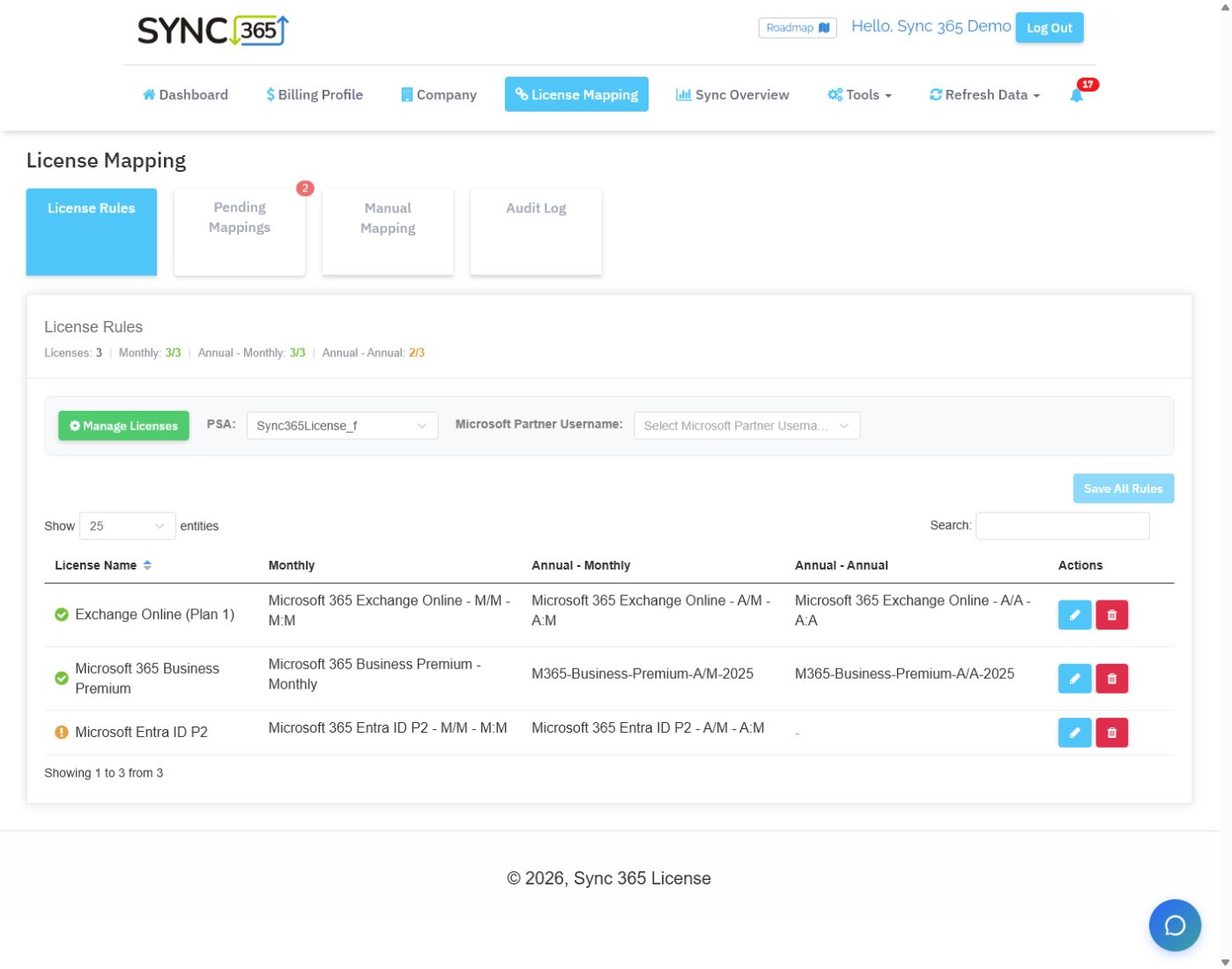
Set the licence, commitment-term, billing-profile and PSA destination rules once. When matching subscriptions appear, AutoMap can apply those rules automatically or queue them for approval.

  • Separate defaults for monthly and annual Microsoft commitment terms
  • Company and filter-group PSA destinations
  • Automatic mapping for trusted setups or pending approval for exceptions
Explore AutoMap
Sync 365 AutoMap settings with separate Microsoft licence term and PSA destination rules

Custom licences

Bill the recurring services around the Microsoft licence

Create the active-user or managed-user count your MSP actually sells, then use it across related support, backup, security and filtering lines in the PSA.

Explore custom licence billing
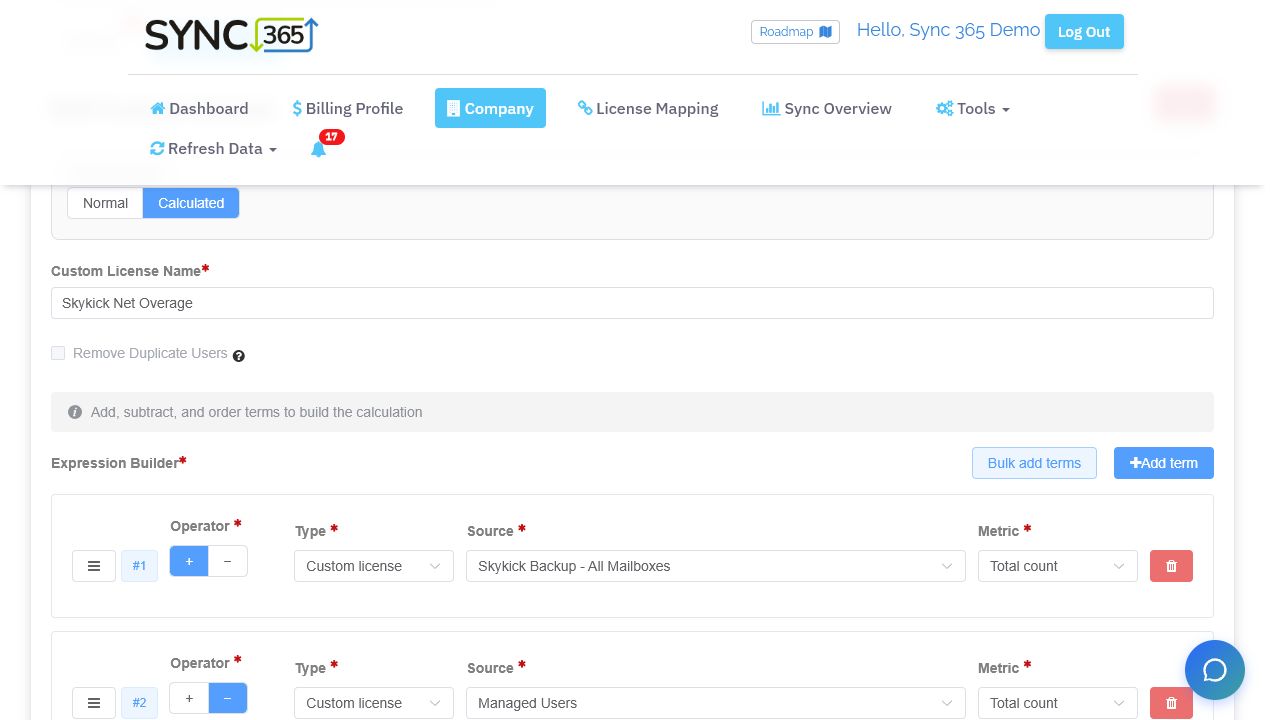
Sync 365 calculated custom licence builder adding and subtracting recurring service quantities

Calculated custom licences

Turn several source counts into one explainable quantity

Add and subtract Microsoft licences, subscriptions, users, custom licences or fixed quantities to model bundles, included seats and overages before the result reaches the PSA.

Explore calculated billing
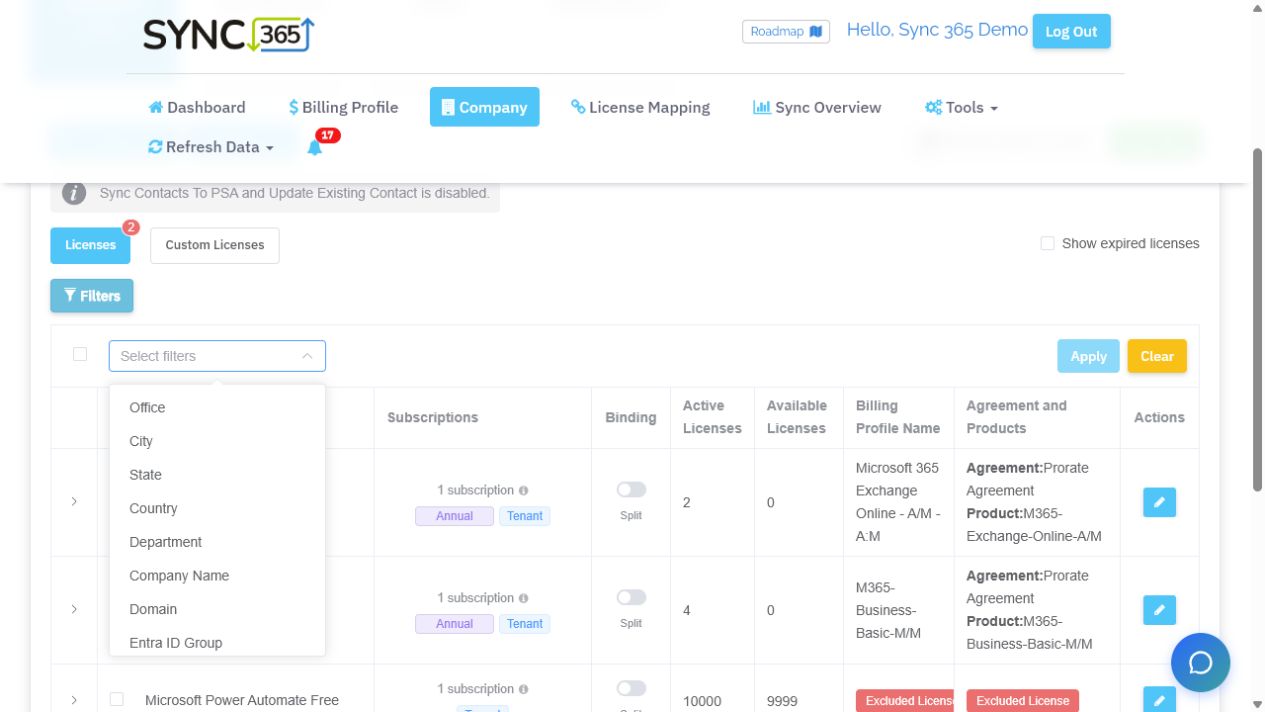
Sync 365 licence filters for office, city, state, country, department, company, domain and Entra ID group

Filters and split billing

Bill by location, department, group or billing entity

Split one Microsoft tenant into separate billable populations using office, city, state, country, department, company, domain, Entra ID group or custom attributes.

Explore filters and split billing

At a glance

Sync 365 and ConnectWise PSA Cloud Billing at a glance

Compare how much repeat work is automated after setup: new-subscription routing, custom and calculated quantities, tenant splits, Azure controls, and the final PSA update.

A source-attributed workflow comparison of Sync 365 and ConnectWise PSA Cloud Billing, reviewed 2026-08-28.
What mattersAutomates repeat billing workSync 365ConnectWise PSA Cloud BillingWhy it matters
Primary billing jobMicrosoft billing automationA focused Microsoft billing layer for licences, Azure, managed users, contacts, and custom recurring services while the supported PSA remains the invoicing system of record.[6][2][5]In-PSA cloud billingConnectWise PSA Cloud Billing provides an in-PSA workflow for supported subscription and usage billing after the required company, product, agreement, and subscription relationships are configured.[7][8][9]A simple in-PSA workflow may be enough; more varied Microsoft billing logic benefits from a purpose-built automation layer.
New subscription mappingReusable subscription rulesAutoMap applies reusable Microsoft licence and commitment-term rules to matching new subscriptions, routing each to the configured billing profile and PSA destination automatically or pending review.[1]Configured subscription reviewConnectWise PSA Cloud Billing can track licence-count changes and new SKUs. Its published Microsoft workflow also includes company and subscription review, “Do Not Bill” decisions, and agreement additions; the reviewed material does not describe Sync 365’s reusable term-aware AutoMap route.[8][9]A reusable mapping rule saves repeat setup when new subscriptions appear and reduces the chance that one waits for attention before billing cutoff.
Custom recurring servicesUser-driven service billingA configured Microsoft or managed-user count can keep support, backup, antivirus, security, filtering, and other related recurring PSA lines aligned.[2]Cloud-product agreement additionsConnectWise PSA Cloud Billing centres its public workflow on cloud products and agreement additions. Buyers should test separately how managed-user counts would keep several non-licence recurring lines aligned.[7][9]MSPs often sell a service bundle around each user, not only the underlying Microsoft licence.
Calculated quantities and overageCalculated billing rulesCalculated custom licences add and subtract Microsoft licences, subscriptions, users, custom licences, or fixed values to produce bundles, included-seat deductions, and overage quantities.[3]Quantity builder not documentedThe reviewed ConnectWise PSA Cloud Billing material does not document an add-and-subtract quantity builder for bundles, included seats, overage, or deduplicated users; verify any comparable workflow directly.[7]The correct quantity may be a formula—such as protected mailboxes minus users already included in the bundle—not a copied vendor count.
Location, department, and split billingAttribute-based split billingOffice, city, state, country, department, company, domain, Entra group, and custom attributes can split one tenant into separate billable populations and PSA records.[4]Company-level configurationConnectWise PSA Cloud Billing documents company and agreement configuration. The reviewed material does not describe deriving several billable populations from one tenant by department, location, domain, Entra group, or custom attribute.[8][9]One Microsoft tenant can represent several sites, departments, franchises, cost centres, or legal billing entities.
Azure consumption workflowAzure review and postingAzure consumption can move through billing profiles, markup, billing-period review, approval or configured auto-approval, and supported PSA posting.[5]Package-dependent cloud billingConnectWise PSA Cloud Billing lists cloud-infrastructure billing in the Premium PSA package. Confirm entitlement and test the exact Azure markup, approval, exception, and posting workflow your finance team requires.[10]Azure comparison should include data timing, markup, period review, approval, exception handling, and the final PSA record—not only ingestion.
PSA ownership and scopeMulti-PSA billing layerSync 365 supports ConnectWise Manage, Autotask PSA, and HaloPSA workflows while the PSA remains responsible for invoices.[6]ConnectWise-native workflowConnectWise PSA Cloud Billing stays within ConnectWise PSA. That can reduce procurement friction when the relevant capability is already licensed, but it does not provide Sync 365’s multi-PSA Microsoft billing-automation layer.[7][10]Package entitlement, supported PSA choice, and clear system ownership all affect the time and cost of the final workflow.

Beyond one-to-one sync

Build the quantity your MSP actually bills

Start with Microsoft, managed-user or recurring-service data. Apply the commercial rule. Keep the related PSA lines aligned without rebuilding the logic in a spreadsheet each month.

Billing sources

Start with the count the service actually uses

  • Active managed-user counts
  • Protected mailbox counts
  • Microsoft licence and subscription counts
  • Counts filtered by department, site or franchise

Sync 365 billing rules

Build the billable quantity

  • Minimums and exclusions
  • Add or subtract source counts
  • Remove duplicate users
  • Customer-specific mappings

Automated PSA billing

  • Managed support
  • Microsoft 365 backup and overage
  • Antivirus, EDR or email security
  • Web filtering and other recurring services
Managed-service bundle10 active managed users can keep 10 managed support, backup, antivirus and web filtering quantities aligned in the PSA.
Mailbox backup overage13 protected mailboxes minus 10 included users becomes a 3-seat backup overage that Sync 365 can calculate and sync to the PSA.

Workflow differences

What changes in day-to-day billing

These are the practical differences to test with your own customer data—not a generic feature-score exercise.

Map the rule once—not every new subscription

AutoMap applies the routing decision again when matching subscriptions appear, reducing repeat billing setup.

With Sync 365

Configure monthly and annual Microsoft commitment-term defaults, the Sync 365 billing profile, the company or filter-group PSA destination, and automatic or pending approval. Matching new subscriptions can then follow that route.[1]

With ConnectWise PSA Cloud Billing

ConnectWise PSA Cloud Billing documents company-level subscription review, “Do Not Bill” choices, agreement additions, and related setup. Its reviewed public material does not describe the same term-aware rule that routes a matching new subscription to both a billing profile and PSA destination.[8][9]

Why it matters

The useful distinction is not whether a product can sync a count. It is whether new Microsoft subscriptions inherit the right commercial and PSA-routing decisions without rebuilding the mapping each time.

Bill more than the Microsoft licence

Turn the trusted user or licence count into the support, backup, security, and filtering lines the MSP actually sells.

With Sync 365

Custom licences can use managed users, filtered licences, minimums, exclusions, and customer rules. One configured count can drive several related recurring items through their billing profiles into supported PSA records.[2]

With ConnectWise PSA Cloud Billing

ConnectWise PSA Cloud Billing centres its public workflow on cloud products and agreement additions. Buyers should test separately how managed-user counts would keep several non-licence recurring lines aligned.[7][9]

Why it matters

A Microsoft seat count can be correct while the surrounding managed-service invoice is still wrong. Keeping related lines tied to one reviewed quantity reduces that drift.

Build the exact quantity, including bundles and overage

Use ordered additions and deductions when the billable number does not exist in any single source system.

With Sync 365

Calculated custom licences can combine Microsoft licences, subscriptions, all users, custom licences, and fixed quantities. Rules can apply filters, configured duplicate removal, included-seat deductions, and a zero floor before mapping the result to the PSA.[3]

With ConnectWise PSA Cloud Billing

The reviewed ConnectWise PSA Cloud Billing material does not document an add-and-subtract quantity builder for bundles, included seats, overage, or deduplicated users; verify any comparable workflow directly.[7]

Why it matters

Finance gets an explainable recurring result for rules that otherwise tend to live in spreadsheet formulas, custom scripts, or month-end adjustments.

Filtering that changes the bill—not only the view

Keep one tenant while producing separate location, department, franchise, group, or entity-specific billing populations.

With Sync 365

Sync 365 can include or exclude users by Microsoft and Entra attributes, map each filtered population to the relevant PSA record, and use a separate AutoMap destination for each filter group.[4][1]

With ConnectWise PSA Cloud Billing

ConnectWise PSA Cloud Billing documents company and agreement configuration. The reviewed material does not describe deriving several billable populations from one tenant by department, location, domain, Entra group, or custom attribute.[8][9]

Why it matters

The tenant-wide total is often wrong for a multi-site or multi-entity agreement. Billing populations should reflect the customer structure that finance actually invoices.

Built around real MSP billing

The difficult billing scenarios are the point

Sync 365 customer stories show custom recurring rules and split-tenant billing working in live MSP operations.

Custom recurring billing

“Everyone can do 365 licensing. It’s the custom stuff I need.”

Chris F, Operations Director · Cleva Group

Read the Cleva Group story

One tenant, many billing records

“There’s no way we would be able to service a customer like that manually.”

Sean Stuart, Operations Manager · IT Global

Read the IT Global story

Customer-specific examples, not typical or guaranteed results.

Best fit

Which option fits your MSP: Sync 365 or ConnectWise PSA Cloud Billing?

Choose around the work you need to remove each month, the source data that determines quantity, and whether the relevant ConnectWise capability is already part of your current package.

Choose Sync 365 when

Choose Sync 365 to automate complex Microsoft billing

Sync 365 fits when an MSP wants to save recurring setup and review time across Microsoft licences, Azure, managed users, custom services, calculated quantities, and customer-specific billing splits.[1][2][3][4][6]

  • Matching new Microsoft subscriptions should inherit reusable term and destination rules.
  • Managed-user services, bundles, overages, minimums, or exclusions change the billable quantity.
  • One tenant needs separate location, department, franchise, group, or entity billing records.

Choose the alternative when

Consider ConnectWise PSA Cloud Billing for simple, already-included needs

ConnectWise PSA Cloud Billing may be enough when an MSP has straightforward subscription or usage billing, uses ConnectWise PSA, and already has the required capability in its current package.[7][8][10]

  • The relevant Cloud Billing capability is included in your current ConnectWise PSA package.
  • Your billing rules are simple and do not require custom calculations or tenant splits.
  • Your team is comfortable with the documented company, agreement, subscription, and review steps.

Use a real customer in the demo

Questions worth testing before you choose

First confirm whether your ConnectWise PSA package includes the relevant ConnectWise PSA Cloud Billing capability. Then compare one simple customer and one difficult customer: a new annual Microsoft subscription, a managed-user bundle, an overage calculation, one filtered department or site, and the final PSA record. Count every mapping, review, and exception step.

  1. 01When a matching new Microsoft subscription appears, what does ConnectWise PSA Cloud Billing configure automatically and what must an operator map?
  2. 02Can ConnectWise PSA Cloud Billing calculate the exact bundle or overage quantity from several Microsoft, user, custom, and fixed counts?
  3. 03Can ConnectWise PSA Cloud Billing split one tenant by location, department, domain, group, or custom attribute into the required PSA records?
  4. 04Which system owns exception review and the final invoice when ConnectWise PSA Cloud Billing is connected?

How Sync 365 fits

From Microsoft data to PSA billing records

The PSA stays in control of invoicing. Sync 365 owns the reusable mapping, quantity and review logic that prepares supported billing records.

  1. 01

    Connect the source data

    Bring Microsoft 365, Azure, managed-user and supported PSA data into one billing workflow.

  2. 02

    Apply the commercial rules

    Use AutoMap, billing profiles, minimums, exclusions, filters and calculated custom quantities.

  3. 03

    Review the exceptions

    Check pending mappings, calculated quantities, billing changes and configured Azure approvals.

  4. 04

    Align the PSA

    Update supported PSA billing records while the PSA remains the invoicing system of record.

Frequently asked questions

Sync 365 and ConnectWise PSA Cloud Billing

What is the main difference between Sync 365 and ConnectWise PSA Cloud Billing?

ConnectWise PSA Cloud Billing keeps supported subscription and usage billing inside ConnectWise PSA and can suit straightforward needs. Sync 365 is a dedicated Microsoft billing-automation layer for reusable AutoMap rules, Azure workflows, filtered populations, custom services, and calculated quantities while a supported PSA remains the invoicing system of record.[1][2][3][4][6][7]

When can ConnectWise PSA Cloud Billing be enough?

It can be a practical fit when the MSP already uses ConnectWise PSA, the relevant Cloud Billing capability is included in its current package, and the required subscription or usage billing is straightforward. Confirm entitlement against your own ConnectWise agreement because the published package table varies Cloud Billing capability by package.[6][7][8][10]

Why choose Sync 365 over ConnectWise PSA Cloud Billing?

Choose Sync 365 when the aim is to remove repeat work across Microsoft and Azure billing: route matching subscriptions with AutoMap, reuse managed-user or custom-service quantities, calculate bundles and overage, and split one tenant by location, department, domain, group, or other customer data. Test the same real customer in ConnectWise PSA Cloud Billing to compare every setup, review, and exception step.[1][5][2][3][4][7][9]

Can an MSP use Sync 365 alongside ConnectWise PSA Cloud Billing?

Both products can involve ConnectWise PSA, but they represent different billing layers. Compare one real agreement to determine which product should own mapping, quantity logic, exception review, and updates. Whichever design you choose, document the system of record and ensure two automations do not update the same customer quantity.[6][7]

Compare with your own billing data

See how much repeat billing work Sync 365 can automate

Use one real Microsoft tenant, one new subscription, one custom or calculated quantity, and one PSA agreement. Compare every setup, review, exception, and update step end to end.

Methodology and sourcesReviewed

How we compared Sync 365 with ConnectWise PSA Cloud Billing

This buyer guide compares documented workflows rather than awarding a generic feature score. A capability not found in the public ConnectWise PSA Cloud Billing material reviewed is labelled as such, not presented as proof that no private or newer capability exists. Product information was reviewed on. Confirm plan, region, integration and workflow details with each vendor before buying.

  1. Sync 365 AutoMap automated Microsoft licence mappingSync 365
  2. Sync 365 custom licence billingSync 365
  3. Sync 365 calculated custom licence billingSync 365
  4. Sync 365 licence filters and split billingSync 365
  5. Sync 365 Azure consumption billingSync 365
  6. Sync 365 supported PSA integrationsSync 365
  7. ConnectWise PSA Cloud Billing documentationConnectWise
  8. ConnectWise Cloud Billing Office 365 FAQConnectWisePublished workflow guidance; buyers should confirm current product behaviour with ConnectWise.
  9. ConnectWise agreement type setup tableConnectWise
  10. ConnectWise PSA package comparisonConnectWisePublished package comparison; confirm current entitlement against your own ConnectWise agreement.