Customer case study
How DAS Health removed manual Microsoft licence reconciliation
DAS Health managed 10,000+ Microsoft licences and needed to move spreadsheet reconciliation into a controlled, PSA-aligned billing evidence workflow.

DAS Health needed fast, reliable evidence showing who changed, what changed and why it mattered commercially. Sync 365 helped move licence reconciliation toward a controlled workflow finance, procurement, service teams, leadership and customers could trust.
- Licences managed10,000+ Microsoft licences under management.
- Previous processSpreadsheet-based manual reconciliation led by finance.
- Main issueLicence counts, dollar figures, finance data and customer billing records did not reliably align.
- OutcomeReduced spreadsheet dependency and clearer PSA-aligned billing evidence.
The problem: spreadsheet reconciliation could not scale
DAS Health manages Microsoft licensing as a high-volume operational process, not a side task. The core issue was alignment between Microsoft licence counts, internal finance data and customer billing records. The team needed reliable evidence showing who changed, what changed and why it mattered commercially.
“Everything was done manually through our finance department, and things just didn't align.” — Mark, Director of Procurement, DAS Health
“Reconciling it manually just wasn't scalable anymore.” — Mark, Director of Procurement, DAS Health
Workflow before Sync 365
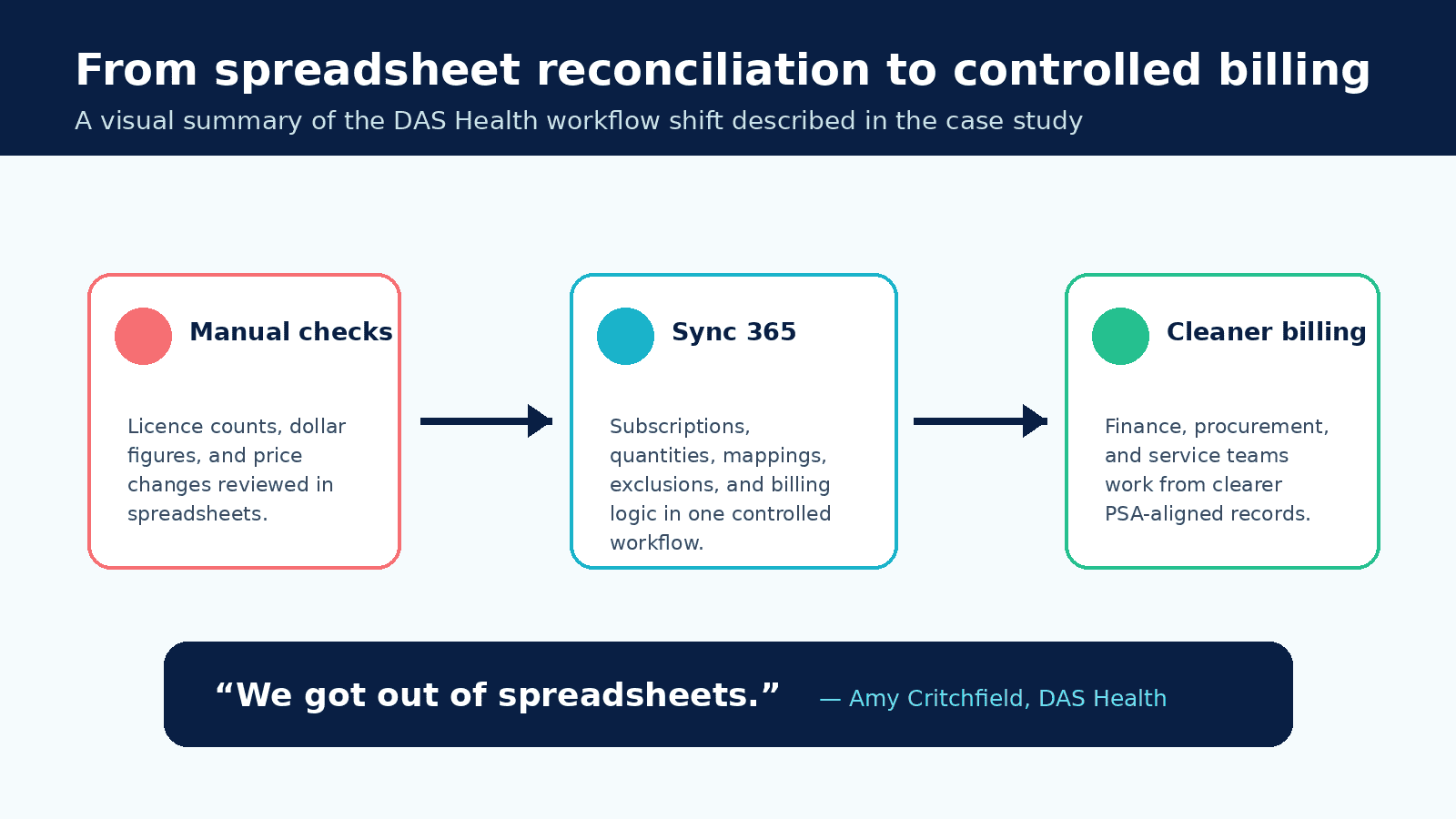
Before adopting Sync 365, DAS Health relied heavily on manual processes to validate Microsoft licence counts, pricing, billing data and customer billing records.
- Licence counts did not always align.
- Dollar figures did not always align.
- Microsoft price changes were hard to reflect cleanly.
- Senior team members spent too much time validating data.
- Spreadsheet-based workflows created operational friction.
- Multi-site customer billing required more granular control.
- Month-end reconciliation was possible, but not scalable.
Why billing visibility mattered
For DAS Health, Microsoft licensing sits at the intersection of vendor management, procurement, finance, licensing operations, margin performance and customer service.
“It was time, margin risk, and internal trust really. But I think time was the bleeding wound.” — Mark, Director of Procurement, DAS Health
Workflow after Sync 365
DAS Health wanted more than a tool that displayed licence counts. Sync 365 gave the team cleaner visibility into subscriptions, licence quantities, customer-level detail, department-level or office-level billing structures and multi-site billing arrangements.
“The performance of Sync 365 was much better than anything else that we were currently using at the time.” — Amy Scritchfield, Licensing Management Analyst, DAS Health
“I could separate it into departments or offices for the customer. That really helped multiple sites for one customer.” — Amy Scritchfield, Licensing Management Analyst, DAS Health
Implementation lesson: clean data first
Sync 365 exposed the importance of clean data. SKU mappings, product names and naming conventions had to be tidied so the automation could follow trusted rules.
“The biggest lift wasn't technical. It was cleaning up our own internal SKU mappings and naming conventions.” — Mark, Director of Procurement, DAS Health
“We quickly uncovered discrepancies we didn't even know existed. That was eye-opening and valuable.” — Mark, Director of Procurement, DAS Health
Outcome
- Spreadsheet dependency was reduced in the Microsoft billing workflow.
- Billing evidence became clearer for finance, procurement, service teams, leadership and customers.
- Customer-level, department-level and office-level billing views became easier to support.
- Licence count accuracy, billing visibility, margin protection and internal trust improved.
- The workflow moved closer to structured, PSA-aligned billing evidence.
“We got out of spreadsheets.” — Amy Scritchfield, Licensing Management Analyst, DAS Health
“The accuracy in the end is beneficial not only to us internally but to the customers on the receiving end.” — Amy Scritchfield, Licensing Management Analyst, DAS Health
“Treat it as a business system. Don't just think of it as a reporting tool.” — Mark, Director of Procurement, DAS Health
Key takeaway
For larger MSPs and Direct CSPs, Microsoft billing reconciliation is a business system. Sync 365 helps move that workflow closer to structured, PSA-aligned billing evidence instead of month-end spreadsheets.
See it on your data
Bill closer to what you deliver
We'll help show where your billing drifts — and how the rules can help close the gap.