Customer case study
How DAS Health evaluated Sync 365 for managed-user billing and multi-site licence logic
DAS Health needed more than Microsoft licence sync: managed-user counts, customer-specific rules, departments, offices and recurring services mattered.

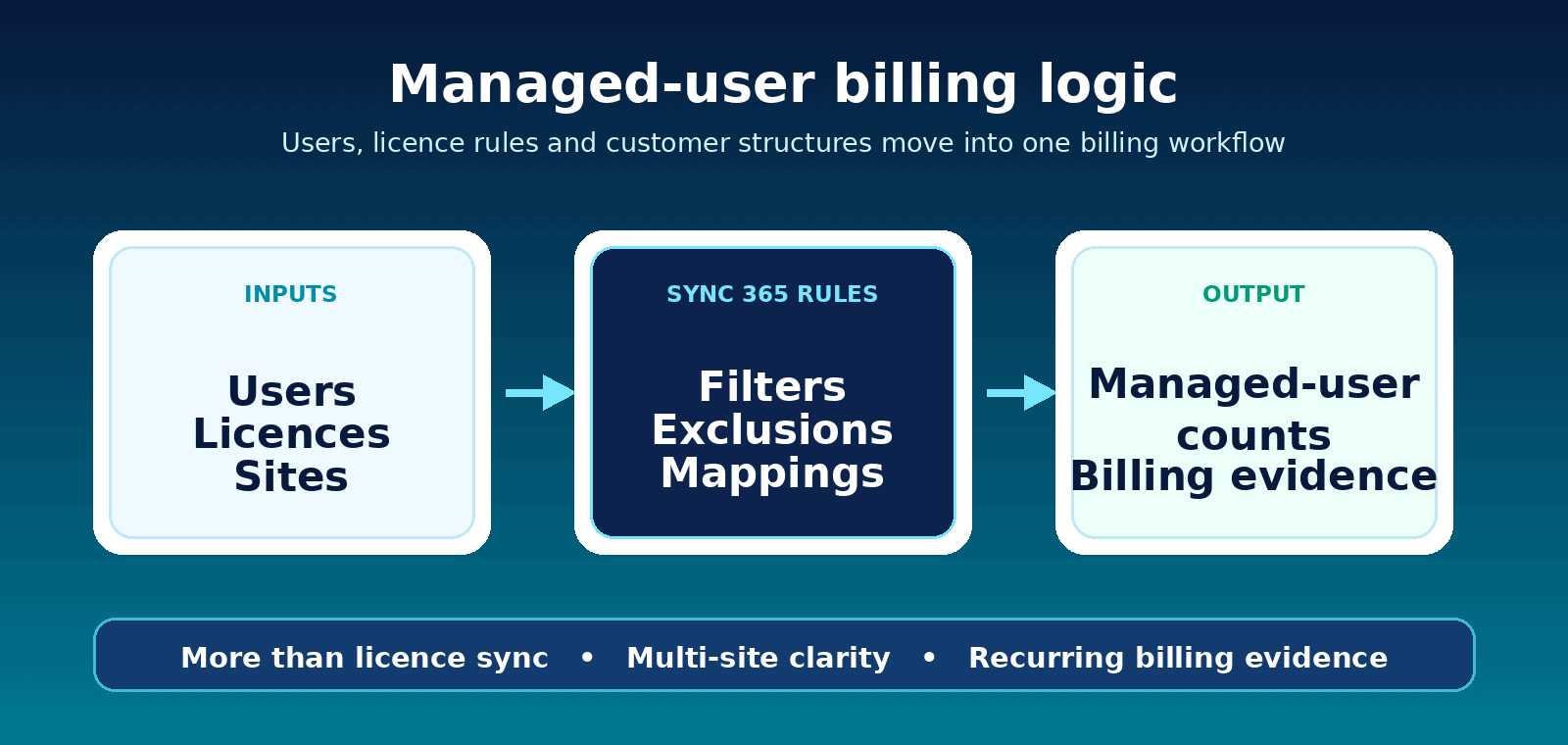
DAS Health needed billing logic that could account for active users, licence types, customer-specific profiles, departments, offices, sites, filters, exclusions and mappings that reflect real agreements.
- Managed-user countsSupport for recurring services beyond basic licence quantities.
- Customer rulesProfiles, filters, exclusions and mappings for complex workflows.
- Multi-site visibilityDepartment and office structures for non-flat accounts.
- Rules-based evidenceUsers and licences feeding recurring outcomes that can be reviewed.
Problem: Microsoft licence sync was only the starting point
Most MSPs begin by trying to fix Microsoft licence reconciliation. Mature MSPs quickly run into the next question: what about recurring services that depend on users, sites, departments and customer-specific rules?
That was one reason DAS Health evaluated Sync 365. The team needed flexibility beyond a basic licence-count sync.
“I wanted it to not only bill for Microsoft licenses, but bill for our user MSP counts.” — Mark, Director of Procurement, DAS Health
The billing gap: user counts changed, but invoices did not always follow
In managed services, billing often depends on more than a single Microsoft product quantity. A customer may add users, move users between departments, or need specific recurring services billed according to their agreement.
“When one of our clients increases their user count, their user count isn't increasing over here on their invoices.” — Mark, Director of Procurement, DAS Health
What the workflow needed to handle
The requirement went beyond standard Microsoft 365 licence sync. The team wanted to account for:
- Active users and licence types.
- Managed-user counts for MSP recurring services.
- Customers with multiple departments, offices or sites.
- Customer-specific billing profiles and rules.
- Filters, exclusions and mappings that reflect real agreements.
Why custom licence logic mattered
During evaluation, DAS Health asked whether Sync 365 could support billing models beyond standard licence reconciliation. The answer mattered because advanced recurring billing is where many MSP workflows become fragile.
“Leon’s like, ‘Yeah, we got that. Watch. I’ll show you. Custom license. Here you go. This is what you do.’” — Mark, Director of Procurement, DAS Health
Multi-site and department billing
Amy Scritchfield highlighted the ability to work with customers at different levels. That matters when one account includes multiple offices, departments or billing views.
“I could do them as a whole for a customer, or I could separate it into departments or offices.” — Amy Scritchfield, Licensing Management Analyst, DAS Health
Why this matters for MSP recurring revenue
Every MSP has customer-specific billing rules living somewhere: in a PSA, product mappings, finance notes, a spreadsheet or someone’s head. The risk grows when those rules are manual and easy to miss.
The key shift: managed-user billing, minimum quantity logic, recurring service rules and licence filters are not edge cases for mature MSPs. They are the operating reality of recurring revenue.
Where Sync 365 fits
Sync 365 supports custom licence billing and managed-user billing workflows for MSPs that need more than basic Microsoft licence sync. That includes billing profiles, filters, exclusions, mappings, managed-user counts and recurring billing logic that can be reviewed more consistently.
“The relationship between us and Sync 365 is going to work out well just based on our thought structure and how we're thinking about future alignment.” — Mark, Director of Procurement, DAS Health
The bigger lesson
Microsoft licence reconciliation is important, but it is only one part of recurring revenue control. For MSPs with complex customers, the real value comes from turning customer-specific billing rules into a workflow that can be checked, repeated and trusted.
Explore licence filters & split billingBook a technical billing walkthrough
See it on your data
Bill closer to what you deliver
We'll help show where your billing drifts — and how the rules can help close the gap.