The MSP ‘Courtesy Cushion’ Margin Leak: How Spare Microsoft Seats Quietly Break PSA Billing Alignment
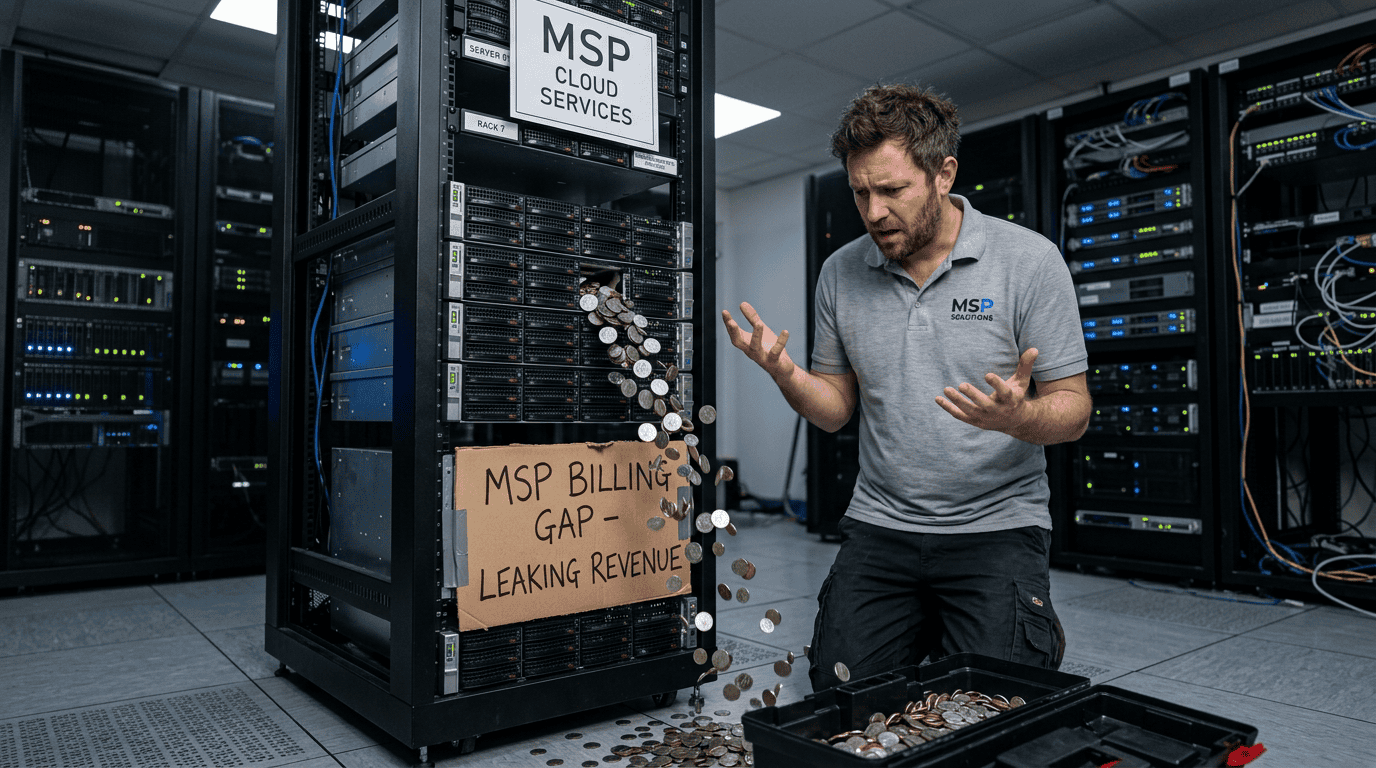
Most MSPs hold a few spare Microsoft seats per tenant so they can onboard a new joiner in minutes rather than hours. That buffer is good operations, but it quietly creates CSP license margin leakage when those paid seats never make it into your PSA billing — and this article shows you how the gap forms and what to do about it.
Key takeaways
- A spare-seat buffer is a provisioning decision that has been silently turned into a pricing decision.
- The leak lives in the gap between the Microsoft tenant count, the distributor invoice, and the PSA agreement quantity.
- NCE annual terms lock seat counts after a 7-day window, so buffer seats can carry for the full term.
- With 12–18% base CSP margins, even one unrecovered seat erodes a meaningful share of account profit.
- Every spare-seat policy needs a reconciliation bridge between tenant reality and PSA billing to actually work.
The Courtesy Cushion Is Good Operations. The Billing Gap It Creates Is Not.
Onboarding a new joiner takes minutes if a Business Premium seat is already provisioned and waiting. It takes hours — sometimes a day — if you first have to raise a CSP order, wait for provisioning, then assign the licence.
For MSPs on tight SLAs or in high-churn environments, holding 2–5 spare paid seats per tenant is a defensible service-delivery choice, not a licensing mistake.
Let’s be precise about what the courtesy cushion actually is. These are paid Microsoft 365 seats — active, provisioned, and fully billable to you by Microsoft — but unassigned to named users and held in reserve.
They aren’t trial licences or free SKUs. They are real line items on the distributor invoice.
The New Commerce Experience sharpens the stakes. Under Microsoft’s Partner Center policy, annual subscriptions have a 7-day post-purchase window to reduce seat counts without penalty; after that, the committed count is locked for the term.
Add five buffer seats mid-month to a 50-seat annual Business Premium subscription, and you carry those five for the duration. Monthly terms offer flexibility but carry roughly a 20% premium over annual pricing, and from April 2025 annual-commitment subscriptions billed monthly add a further 5% premium. The flexible buffer has a real, calculable cost — and our breakdown of NCE commitment models explains how those terms interact.
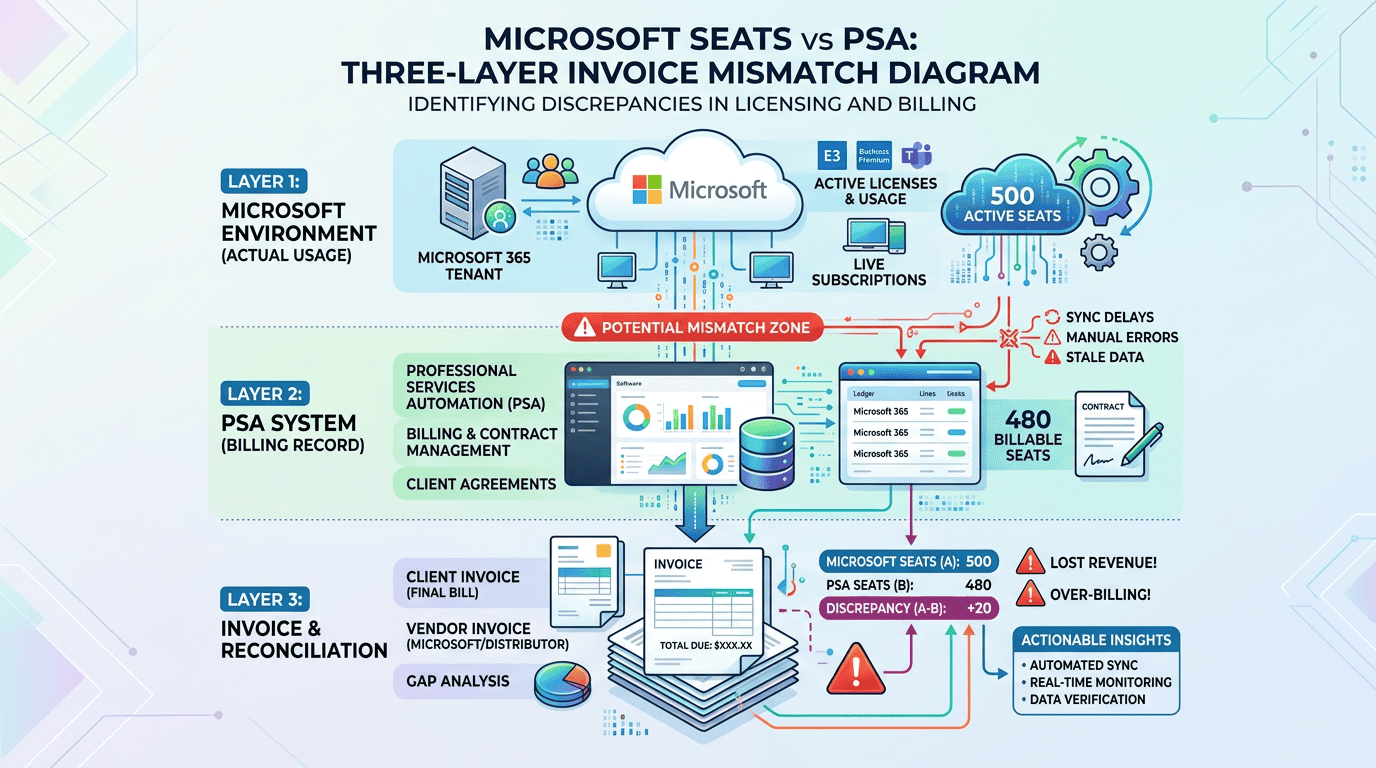
The problem isn’t the buffer. It’s that the PSA almost never knows the buffer is there. Picture the three layers:
- Layer 1 — Microsoft tenant: 55 Business Premium seats active and paid (50 users + 5 buffer).
- Layer 2 — Distributor invoice: billed for 55 seats at the CSP price.
- Layer 3 — PSA agreement and customer invoice: generated from a named-user count or last-synced quantity of 50.
The gap between Layer 1 and Layer 3 is the leak. No single system is wrong — there’s simply no reconciliation bridge between provisioning reality and invoice logic.
At Cloudmore’s benchmarked 12–18% CSP gross margins, a single unrecovered Business Premium seat (CSP cost around £20–22/month under post-2026 pricing) isn’t noise. It’s a meaningful slice of the margin you earn on every paying seat, and it scales across tenants.
Why the Leak Is Invisible — And How It Compounds
Spare-seat leakage doesn’t surface in standard MSP reporting because most margin reporting is invoice-led. Gross margin is invoiced revenue minus COGS, and COGS is usually the distributor bill.
If the PSA invoices 50 seats and the distributor charges for 55, and nobody cross-references the two, the report shows a margin that’s structurally too low — but neither figure looks wrong on its own, so nobody investigates.
Four failure modes keep the gap hidden:
- Named-user billing vs tenant reality: the PSA syncs to the last confirmed quantity and doesn’t follow seats a technician adds directly in the admin centre.
- Bundles obscure seat costs: inside a per-user “Modern Workplace” package, the licence cost is buried, so spare seats quietly thin the managed services bundle margin with nothing to flag the cause.
- Fragmented ownership: the technician adds the seat, the billing analyst bills the contract, and finance sees the squeezed margin — three people, three data sources, never the same picture.
- Offboarding ghost seats: a leaver’s licence is unassigned but not cancelled, so the tenant keeps paying. CoreView research indicates 10–30% of M365 licences in large estates are unused or underutilised, with better management cutting total M365 cost by around 14%.
A few illustrative numbers, framed as directional rather than benchmarks. A 100-seat Business Standard customer with a 5-seat buffer at roughly £14/seat costs £70/month, or £840/year. At a 15% target margin, you’d need about £4,900 of annual billing just to recover what that buffer costs.
Now scale it. A 50-tenant MSP averaging 80 seats per tenant with a 4% buffer (3.2 spare seats) at £16/seat loses about £2,560/month, or £30,720/year. At the ~8.9x median MSP EBITDA multiple (Aventis Advisors, 2024), that’s roughly a £273,000 drag on implied valuation.
And inside a bundle, each spare seat carries implicit support scope too — helpdesk, endpoint management, onboarding. Spare seats inside a bundle aren’t free capacity; they’re unpriced commitments.
Manual spreadsheet reviews catch this occasionally, not consistently — and around 12.5% of manual invoices contain errors per Sigitek research cited by FlexPoint. The real cost of that approach is covered in our piece on manual reconciliation costs.
This is where Sync 365 fits. Its Company Info License page shows active and unassigned licence counts per tenant as a standing view, while the “Available / Unused Licenses” alert and “No Billing Profile Assigned” alert surface the gap between provisioned and billed seats — without requiring a monthly audit.
Three Commercial Policy Models for the Courtesy Cushion
Spare seats aren’t an operations problem. They’re a commercial policy decision that’s been delegated, by default, to whoever provisions seats. Here are three defensible options.
Model 1 — Bill the buffer
Every provisioned seat is billed. The PSA agreement quantity mirrors the tenant count, buffer included, with proration for mid-cycle adds. This needs daily Microsoft seat buffer billing reconciliation — Sync 365 syncs licence counts to PSA agreements daily with proration, which is what makes this viable at scale. Frame it to customers as reserve capacity tied to a provisioning SLA, and cap the buffer contractually.
Model 2 — Absorb the buffer with full visibility
You consciously choose not to bill a defined number of spare seats, treat it as a service-quality overhead, and document it. Sync 365’s “Included License Quantity” deducts a set number from the billed total, while “Minimum License Quantity” holds a contracted floor — together they let you absorb a capped buffer while finance sees it as a named line item. Our note on minimum licence quantity covers the mechanics. Review the cap quarterly so a 2-seat buffer doesn’t quietly become a 10-seat one.
Model 3 — Eliminate the buffer through process
Provision only on approved request, achieving speed through automation rather than pre-paid inventory. NCE’s 7-day window means a just-in-time annual seat can be cancelled at prorated cost if a hire falls through. This suits stable-headcount customers more than high-churn ones.
All three models share one prerequisite: a reconciliation mechanism connecting tenant data to PSA agreement quantities. Without it, Model 1 can’t bill the buffer, Model 2 can’t see the cost, and Model 3 can’t prove the buffer is truly zero. PSA billing alignment is what enforces the policy.
A quick diagnostic. Answer honestly:
- Can you name the exact unassigned paid seat count across your top 10 tenants by MRR right now?
- Does each PSA agreement quantity match the Microsoft tenant count, or the last manual review?
- Are bundled spare seats priced into the per-user economics with explicit cost allocation?
- Has finance ever seen a line item called “buffer overhead”?
- Does your service agreement define the buffer, its size, and whether the customer pays for it?
Three or more “no” or “unsure” answers means the courtesy cushion is working as a margin leak, not a feature — and consistent Microsoft CSP license reconciliation across MSP spare Microsoft seats is the only way to close it.
Before your next billing cycle, look at your own tenant-to-PSA count alignment — and ask whether your current tooling makes that comparison automatic or manual. The policy is the easy part. The reconciliation is what enforces it, and Sync 365 helps MSPs keep Microsoft licence counts and PSA billing records aligned so that check runs daily instead of once a quarter.
Want to close the gap before the next billing run?
If spare Microsoft seats are drifting away from PSA agreement quantities, Sync 365 can help you compare Microsoft tenant reality with PSA billing records before the leak becomes another month of lost margin.
Book a Sync 365 demo to see how Microsoft licence reconciliation can help keep your customer billing aligned.