
How DAS Health Removed Manual Microsoft Licence Reconciliation
Sync 365 helped DAS Health replace spreadsheet-based Microsoft billing checks with cleaner PSA-aligned billing evidence.
Billing reconciliation view
Problem: spreadsheet reconciliation could not scale
DAS Health is a healthcare-focused MSP and Microsoft Direct CSP. Microsoft licensing is a high-volume operational workflow, not a side task.
The issue was alignment: Microsoft licence counts, internal finance data, and customer billing records needed to match more reliably as volume grew.
That meant the story needed to get to proof quickly: who changed, what changed, and why it mattered commercially.
Workflow before: manual reconciliation could not keep up
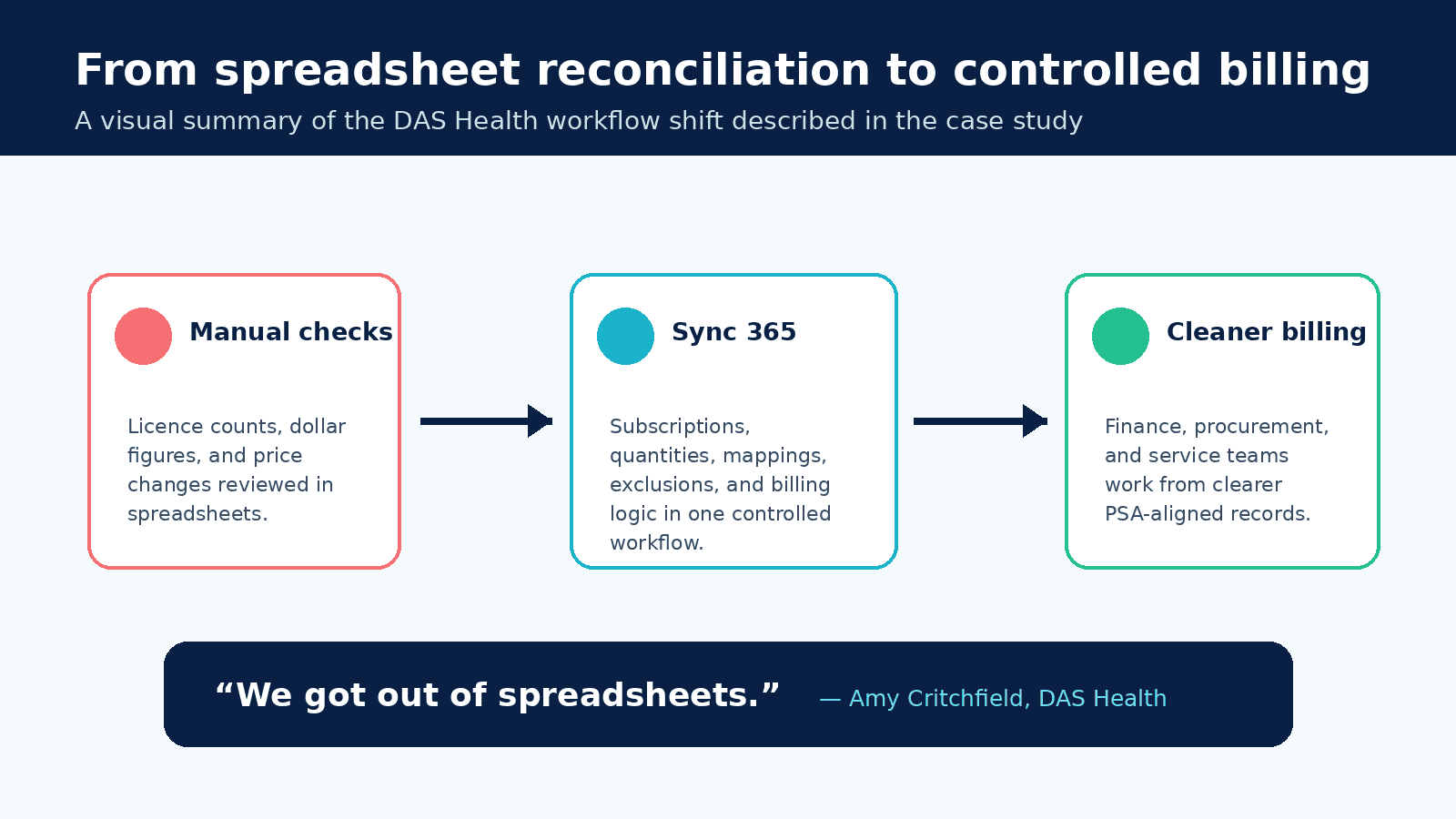
Before Sync 365, the DAS Health team relied heavily on manual processes to validate Microsoft licence counts, pricing, and billing data.
The problems were practical:
- Licence counts did not always align.
- Dollar figures did not always align.
- Microsoft price changes were difficult to reflect cleanly.
- Senior team members spent too much time validating data.
- Spreadsheet-based workflows created friction.
- Multi-site customer billing needed more granular control.
The issue was not only whether someone could reconcile the data at month end. The issue was whether the process could scale as Microsoft licensing volume grew.
DAS Health needed a single source of truth for Microsoft billing data.
Why it mattered: billing visibility affected multiple teams
For Mark’s team, Microsoft strategy sits at the intersection of vendor management, licensing, and margin performance.
That made billing visibility a business issue, not only a finance issue.
When Microsoft licence data, internal finance data, and customer billing records drift apart, several teams feel the impact:
- Finance has to reconcile and defend billing data.
- Procurement has less visibility into margin performance.
- Service teams field client questions without clean evidence.
- Leadership loses confidence in billing accuracy.
Workflow after: controlled billing visibility through Sync 365
DAS Health wanted a platform that could support real MSP billing complexity, not only show licence counts.
Amy Scritchfield, Licensing Management Analyst at DAS Health, highlighted Sync 365’s performance and flexibility during the evaluation.
The team valued the ability to view subscriptions, licence quantities, and customer-level detail without handling everything licence by licence.
Sync 365 also gave DAS Health more granular options for customer billing structure.
That mattered because larger customers do not always bill cleanly at one flat company level. Departments, offices, and sites can each need clearer visibility into what they have and what they are being billed for.
Operational outcome: cleaner visibility and less spreadsheet dependency
The most immediate value was not a flashy dashboard. It was a cleaner operational process.
DAS Health reported improvements around:
- Billing visibility.
- Internal confidence.
- Licence data accuracy.
- Multi-site customer clarity.
- Reduced spreadsheet dependency.
- Better alignment across finance, procurement, and service teams.
The team also connected billing accuracy to the client experience.
For DAS Health, Sync 365 helped turn Microsoft billing into a more controlled business process: cleaner data, clearer responsibility, and better visibility into the billing logic that protects margin.
Implementation note: clean data made the workflow stronger
The implementation surfaced an important lesson for any MSP with years of billing data: the hard part is often not the tool. It is the internal billing data that the tool exposes.
DAS Health used onboarding to clean up:
- SKU mappings.
- Product naming conventions.
- Internal billing structure.
- Legacy data inconsistencies.
Once the internal data was cleaned up, the technical onboarding became more straightforward.
The process also exposed billing issues that were hard to see inside the old workflow.
Advice for other MSPs
Mark’s advice to other MSPs was simple: treat Microsoft billing as a business system, not just a reporting workflow.
He also recommended involving finance and procurement early, cleaning up product catalogues and SKU mappings before go-live, and being ready to act on what the data shows.
That is the uncomfortable part of better billing visibility. Once the gaps are visible, they need ownership.
Where Sync 365 fits
Sync 365 helps MSPs and Microsoft CSPs automate Microsoft 365 licence reconciliation, managed-user billing, custom recurring billing, and related PSA billing updates.
For MSPs managing high Microsoft licence volume, Sync 365 can help reduce manual billing admin, make Microsoft billing easier to explain, and keep billing data aligned with the PSA as the system of record.
DAS Health’s story shows why this matters at scale: when Microsoft billing depends on spreadsheets and manual validation, the process eventually becomes too fragile for the business it supports.
Ready to see where Microsoft licence billing is leaking time, visibility, or margin?
Book a billing automation demo with Sync 365 and see how Microsoft billing reconciliation can work without spreadsheet dependency.
Book a billing automation demo